

How to Fix AdBlue Crystallisation

Dealer Alternative for AdBlue Repairs
June 19, 2026
NOx Sensor Repair: Fix or Replace?
June 23, 2026
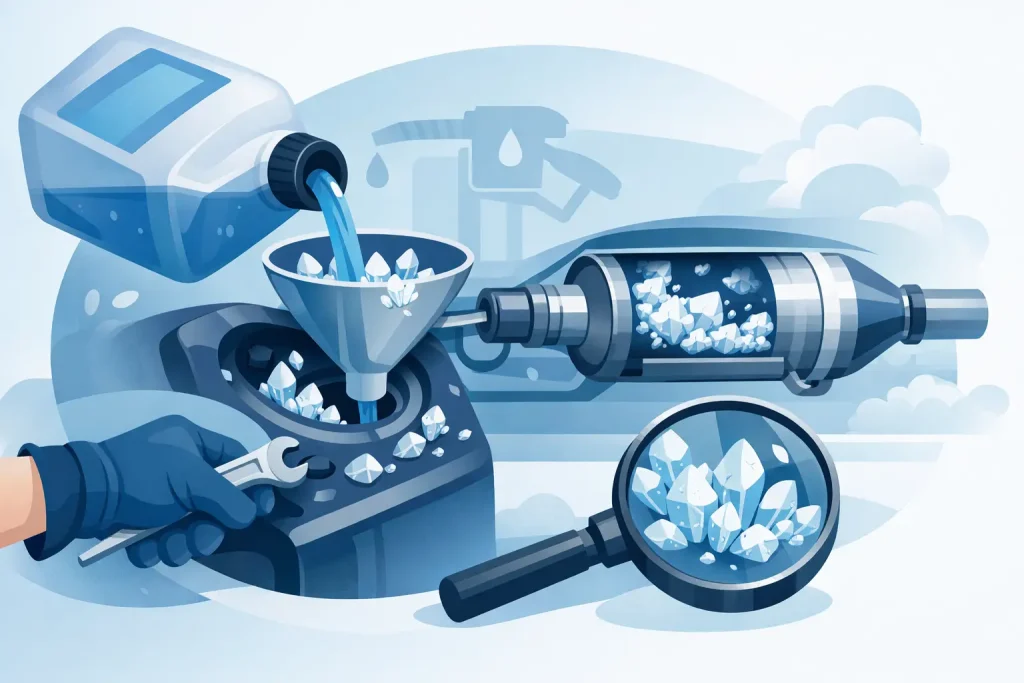
If your diesel has started throwing up AdBlue warnings, countdown messages or refusing to clear a fault after a refill, there’s a good chance crystallisation is behind it. When people ask how to fix AdBlue crystallisation, they usually want one thing – stop the warning, stop the hassle, and stop it coming straight back a few weeks later.
That matters because AdBlue crystals are rarely just a bit of harmless white residue. In the real world, they clog injector lines, block dosing valves, upset level readings and trigger NOx and SCR faults that can leave you with reduced power or a non-start countdown. A quick wipe might tidy up the mess you can see, but if the build-up has formed inside the system, the proper fix depends on where it is, how bad it is, and what damage it has already caused.
What causes AdBlue crystallisation?
AdBlue is a mix of urea and deionised water. When it leaks, dries out, sits in the wrong conditions or doesn’t dose cleanly, the water evaporates and leaves solid crystals behind. That white chalky deposit around injectors, pipes or tank fittings is the bit most drivers notice first.
The trouble is, crystallisation is often a symptom as much as a fault in its own right. A weak injector spray pattern, a leaking connection, contamination, repeated short journeys or a heater issue in colder weather can all help the build-up start. Once it starts, it can get worse quickly because restricted flow causes poor dosing, poor dosing causes more deposits, and then the system starts chasing its own tail.
On some vehicles, the design of the AdBlue system is part of the problem. Certain vans, SUVs and diesel cars are just more prone to crystallisation than others. That’s why two drivers can service their vehicles the same way and one ends up with repeated SCR faults while the other never sees a warning light.
How to fix AdBlue crystallisation properly
If you want to know how to fix AdBlue crystallisation properly, start with the cause, not just the residue. Cleaning visible crystals without checking the injector, pump, lines, tank quality and sensor readings is how people end up paying twice.
Step 1 – Confirm where the build-up is
External build-up around the injector or filler area is one thing. Internal crystallisation in the dosing injector, feed pipe or pump assembly is another. The first can sometimes be cleaned and monitored. The second often triggers repeat faults unless the blockage is fully removed or the failed part is dealt with.
This is where diagnostics matter. If the vehicle is showing SCR efficiency faults, dosing faults, NOx correlation issues or implausible sensor readings, there may be more going on than a bit of dried AdBlue around a joint.
Step 2 – Clean the affected area the right way
AdBlue crystals dissolve in warm water. That’s the safe starting point for external residue. In light cases, careful cleaning with warm water and non-abrasive cloths can remove deposits from accessible components and fittings.
What you do not want is to attack the area with random chemicals, scrape at plastic fittings, or force debris deeper into the injector or line. That turns a manageable problem into a damaged part. If the injector nozzle is blocked, it needs proper inspection and cleaning, not guesswork.
Step 3 – Check for the fault that caused it
If there’s a leak, a poor seal, a cracked line or an injector that is dribbling instead of atomising properly, the crystals will come back. Same goes for contaminated AdBlue or poor-quality fluid that has been sitting too long. Cleaning without fixing the root cause is just a patch job.
A proper check should look at the dosing injector condition, line pressure where relevant, tank and pump operation, heater performance and sensor data. On many vehicles, fault codes alone do not tell the full story. Live data and system behaviour under command tests are what separate a real diagnosis from parts darts.
Step 4 – Clear faults and confirm the system actually works
Once the system is cleaned or repaired, fault memory needs clearing and the vehicle often needs a proper drive cycle or test routine to confirm dosing is back to normal. This catches out a lot of people. The warning disappears for a moment, then returns because the control unit still sees poor SCR performance.
If the fault comes back straight away, it usually means one of three things. The blockage is still there, another component has failed, or the system has already suffered knock-on issues such as a damaged NOx sensor.
When cleaning is enough – and when it isn’t
This is the bit most garages gloss over. Sometimes cleaning works. Sometimes it doesn’t. It depends how far the crystallisation has spread and whether it has already caused component failure.
If the residue is minor, caught early and limited to an external area around a fitting or injector tip, a proper clean plus fixing the cause may be enough. If the injector is heavily blocked, the pump has been strained, the line is restricted or the vehicle has been logging repeat SCR faults for months, cleaning alone is often a waste of time.
That is why some owners spend good money on injector cleans, tank flushes and sensors, only to end up back where they started. The emissions system is full of linked parts. Once one problem drags the others down, the repair bill can snowball fast.
Common signs AdBlue crystallisation is the real problem
You do not always see the crystals straight away. Sometimes the first signs are on the dash. A recurring engine management light, AdBlue system fault, emissions warning, countdown to no restart or limp mode can all point in this direction.
In practical terms, the usual pattern is simple. The vehicle asks for AdBlue, you refill it, the warning stays on or changes to a system fault, and then the codes keep coming back. On vans and working vehicles, especially those doing stop-start miles, that pattern is common.
Visible white deposits around the injector area, pipe joints or tank fittings strengthen the case. So does a history of repeated AdBlue top-ups without the system behaving normally afterwards.
How to stop AdBlue crystallisation coming back
Prevention is never perfect, because some systems are just poorly behaved, but you can reduce the chances. Use good-quality AdBlue, keep it sealed, avoid old contaminated stock, and do not overfill carelessly. If the vehicle has an early warning sign, deal with it early instead of driving until the countdown begins.
Driving pattern matters too. Diesels used for constant short runs often struggle more with emissions systems generally. That does not mean every short-trip diesel will crystallise, but it does mean the system gets less chance to operate cleanly and consistently.
Most importantly, do not ignore a small leak or a minor warning. AdBlue problems have a habit of starting cheap and turning expensive.
What if the system keeps failing anyway?
This is where the honest answer matters. On paper, you can keep replacing injectors, pipes, pumps, heaters and sensors until the system behaves. In reality, plenty of drivers are stuck in a loop of repeat faults, dealer quotes and wasted downtime.
If your vehicle is already on its second or third AdBlue-related repair, you are not dealing with a one-off tidy-up job. You are dealing with a system that is costing you money and confidence every time it acts up. For a private owner that is frustrating. For a van owner, tradesperson or business user, it is lost earnings.
That is why some drivers choose a full permanent solution instead of feeding the problem. Bolt Remaps deals with these faults every day, and the right route depends on the vehicle, the severity of the issue and whether you want to keep chasing hardware failures or put the problem to bed properly.
How to fix AdBlue crystallisation without wasting money
The cheapest-looking fix is not always the cheapest outcome. A basic clean can help if the issue is light and caught early. But if crystallisation has already caused dosing faults, warning countdowns or repeat SCR errors, the smart move is to diagnose the whole system before spending on parts.
That means being realistic. If the system is salvageable with cleaning and one targeted repair, fine. If the vehicle has become a regular customer for AdBlue faults, then another temporary fix may just buy you a short gap before the next breakdown.
No one with a work van, 4×4 or family diesel wants to spend their week arguing with warning lights and dealer estimates. The right fix is the one that gets the vehicle sorted, keeps it usable and stops the same fault draining your wallet again.
If you are dealing with AdBlue crystallisation now, do not focus only on the white residue you can see. Focus on why it formed, what it has affected, and whether this is still a clean-and-repair job or the point where a stronger fix makes more sense.