

ECU Remap vs Tuning Box: Which Wins?

Top Causes of AdBlue Faults Explained
June 5, 2026
AdBlue Diagnostics: What the Fault Really Means
June 9, 2026
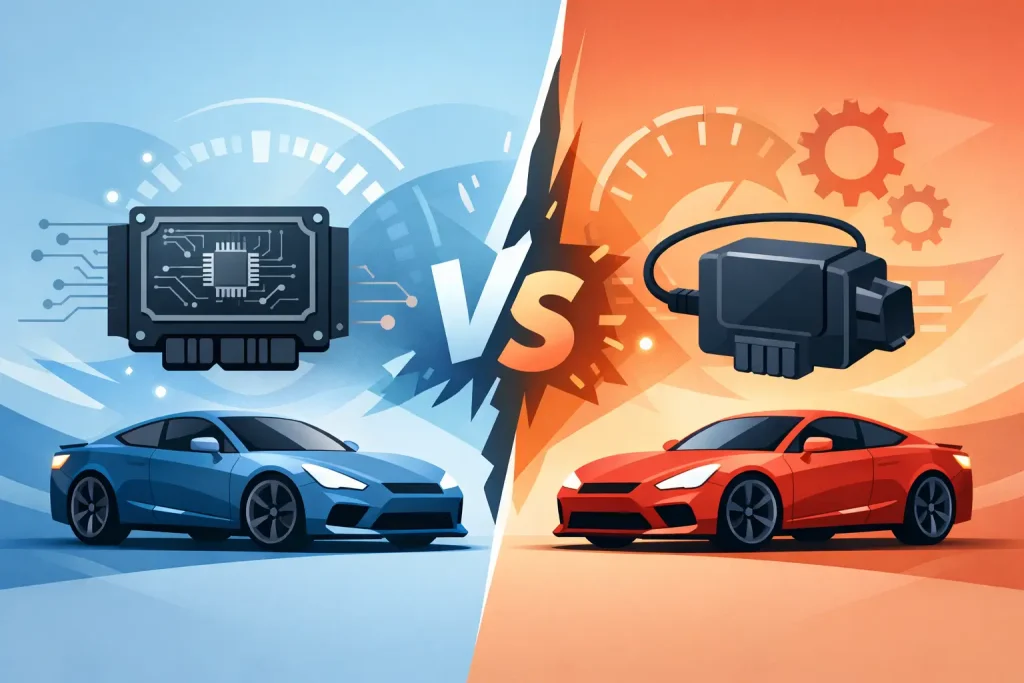
You feel it straight away when a diesel is holding back. Flat mid-range, lazy throttle response, awkward gear changes under load – and then someone says, just fit a tuning box, it’s quicker and cheaper. Fair question. But when it comes to ecu remap vs tuning box, the right choice depends on what you actually want from the vehicle: a proper calibration or a quick add-on.
If you use your car, van or 4×4 every day, this matters more than forum chatter and sales patter. You want more pull, better drivability and fewer headaches, not a setup that feels strong for five minutes and then causes rough running, warning lights or long-term stress on components.
ECU remap vs tuning box – what’s the actual difference?
An ECU remap changes the software inside the vehicle’s engine control unit. In plain English, the factory settings are adjusted properly. That can include boost pressure, fuelling, torque limits, throttle response and, where suitable, gearbox behaviour. It’s tailored to how the engine actually works.
A tuning box is an external module fitted between sensors and the ECU. Rather than rewriting the software, it alters the signals the ECU sees. That usually means the engine is being persuaded to add more fuel or change output based on manipulated data, not a full recalibration.
That distinction is the whole game. One method works with the car’s logic. The other works around it.
Why a remap usually feels better on the road
A lot of drivers don’t care about dyno graphs. They care about how the vehicle behaves when pulling away, overtaking, towing, climbing hills or carrying tools in the back. This is where a proper remap tends to pull ahead.
Because the ECU itself is being calibrated, power delivery can be smoothed out across the rev range instead of dumped into one area. The result is usually a vehicle that feels stronger but also more natural. You press the pedal and the response makes sense. There’s less hesitation, less hunting for gears and less of that on-off surge some cheaper tuning boxes are known for.
On a diesel van or workhorse, that matters. More usable torque lower down the revs can make the vehicle easier to drive every day, not just faster on paper. If your vehicle earns you money, smoother drivability is not a luxury. It keeps the job moving.
Where tuning boxes can appeal
To be fair, tuning boxes exist for a reason. They’re often quicker to fit, easy to remove and heavily marketed to people who want a simple power bump without software work. For some owners, especially those nervous about modifying the ECU, that sounds like the safer move.
But easy to fit is not the same as best to run. A tuning box can sometimes deliver a noticeable gain, especially on turbo diesels, yet the way it delivers that gain is often less refined. You may get more shove, but not always better control.
Power is one thing. Reliability is another.
This is where the ecu remap vs tuning box debate gets real. Any performance change affects engine operation, so the question is not just how much power you can get. It’s how safely and consistently that power is delivered.
A decent remap takes the wider picture into account. It can be built around sensible limits and the condition of the vehicle. If the engine, turbo, clutch or gearbox has known weak points, those should shape the tune. Good tuning is not about chasing the biggest number. It’s about getting gains the vehicle can live with.
A tuning box is generally more blunt. Because it’s intercepting signals rather than rewriting multiple maps properly, it has less control over the full strategy the ECU uses. That can mean higher fuelling without the same level of fine adjustment elsewhere. Sometimes that works well enough. Sometimes it creates smoke, poor economy, rough idle or fault codes.
That’s the bit many adverts skip.
Not every remap is good, and not every tuning box is rubbish
Let’s be straight about it. A bad remap is still bad. If someone loads a generic file with no proper checks, the fact it’s a remap does not magically make it better. Likewise, not every tuning box is junk from the internet. Some are better made than others.
But if you’re comparing the best version of each option, a proper custom or well-developed remap is usually the better engineering solution. It gives more control, better integration and a more factory-like drive.
Fuel economy – don’t believe fairy tales
Both tuning boxes and remaps are often sold with promises of better mpg. Sometimes that happens. Sometimes it doesn’t.
A remap can improve fuel economy if it increases torque in the right areas and helps the vehicle do the same job with less effort. That’s especially true on larger diesels, vans and towing vehicles, where the engine no longer feels strangled. But that saving only shows up if you drive normally. Use the extra performance all the time and your fuel bill will usually reflect it.
Tuning boxes can also show economy gains in some cases, but the results are more hit and miss. If the power delivery is less clean or fuelling is pushed in a cruder way, any claimed savings can disappear fast.
So yes, economy gains are possible. Guaranteed big savings? Usually sales talk.
Warranty, insurance and dealer visits
This is one area where some drivers lean towards a tuning box. Because it can be unplugged, they assume it’s invisible and therefore risk-free. That’s not always how it plays out.
If you modify a vehicle, whether by remap or tuning box, you should tell your insurer. Anything else is asking for trouble. A cheap undeclared mod can become an expensive problem the moment you need to make a claim.
On warranty, it depends on the manufacturer, the vehicle and the type of work being carried out. A tuning box may be removable, yes, but that does not make it consequence-free. A remap is more integrated, but with proper tuning and realistic expectations, many owners still prefer it because the end result is simply better.
If your vehicle is brand new and still heavily tied to manufacturer cover, you may decide to wait. That’s sensible. If it’s out of warranty and you actually want a better-driving vehicle, the balance shifts.
Which is better for diesel cars, vans and 4x4s?
For most diesel applications, especially working vehicles, a remap is usually the stronger option. Diesels respond well to software calibration because torque delivery is such a big part of the driving experience. A good remap can make a van feel less laboured, a 4×4 more usable and a daily driver far less frustrating.
That said, condition comes first. If the vehicle already has underlying faults – boost leaks, injector issues, DPF trouble, AdBlue faults, NOx sensor problems or gearbox complaints – then chasing more power before sorting those issues is backwards. No patch jobs, no BS. Fix the base vehicle first, then tune it properly.
That’s also why a lot of experienced specialists prefer diagnosing before modifying. More performance on top of existing faults rarely ends well.
Cost vs value – the part people remember later
A tuning box often wins on upfront price. That’s the bait. It can look like the cheaper route to more power, especially for drivers comparing headline numbers only.
But value is not just the ticket price. If the vehicle drives worse, throws faults, smokes more, or ends up needing more troubleshooting, the cheap option gets expensive quickly. A proper remap may cost more at the start, but if it gives cleaner power, better drivability and fewer compromises, that’s usually money better spent.
For people who rely on their vehicle – trades, delivery drivers, business users, families doing big mileage – downtime matters. A cheaper mod that creates fresh headaches is no bargain.
So, should you choose a remap or a tuning box?
If you want a quick-fit add-on, plan to remove it later, and you’re willing to accept a more basic approach, a tuning box may suit you. Some drivers go that route and are happy enough.
If you want the vehicle to drive properly, with power delivered in a way that feels sorted rather than faked, a remap is usually the better call. It gives the tuner more control, tends to produce a cleaner result and is generally the stronger long-term option when done right.
For most drivers asking about ecu remap vs tuning box, the answer is simple: if you care about how the vehicle performs day in, day out, not just the sales pitch, go with proper software calibration from someone who understands the platform. That’s why businesses like Bolt Remaps focus on real-world results, not gimmicks.
The smart move is not chasing the cheapest route to extra power. It’s choosing the option that makes your vehicle better to live with every single day.