

NOx Sensor Repair: Fix or Replace?

How to Fix AdBlue Crystallisation
June 21, 2026
AdBlue Pump Failure Symptoms Explained
June 25, 2026
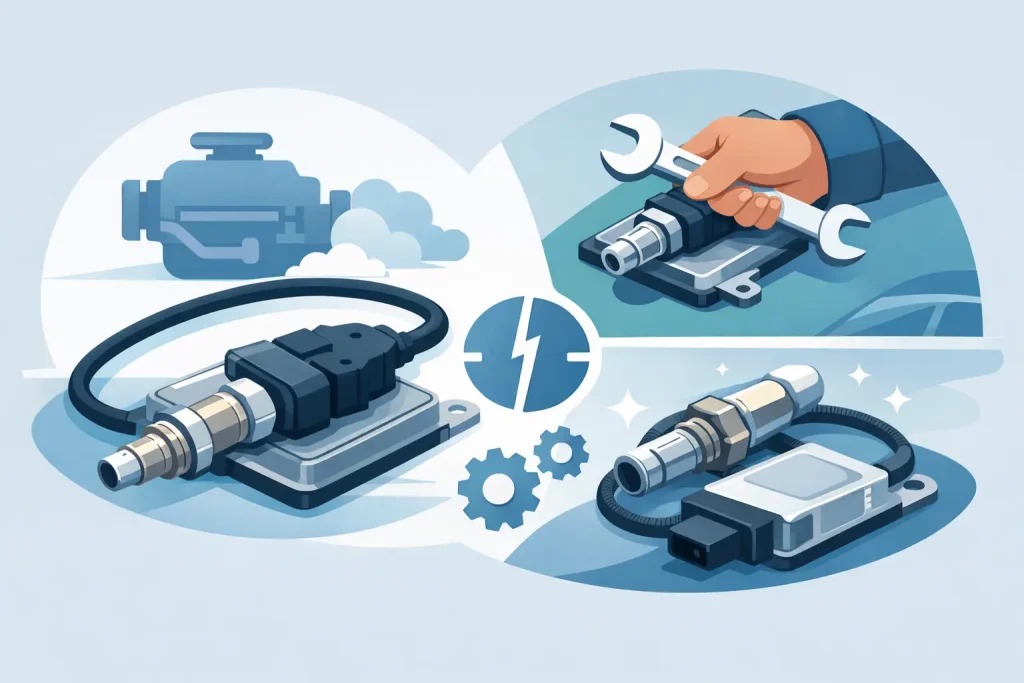
That amber engine light comes on, the AdBlue warning follows, and before long the car feels flat or drops into limp mode. For a lot of diesel owners, that is where the NOx sensor repair question starts. Do you fix the fault properly, replace parts blindly, or keep feeding money into a system that keeps failing?
The hard truth is this: NOx sensor faults are common, expensive, and often misdiagnosed. Main dealers love the parts cannon approach. New sensor, new injector, software update, maybe a tank sender too. The bill climbs fast, and the original problem is not always gone. If you use your vehicle for work, school runs, site visits or long motorway miles, that kind of downtime is more than annoying. It costs you.
What a NOx sensor actually does
A NOx sensor measures nitrogen oxide levels in the exhaust. On modern diesels, that reading helps the ECU manage emissions control systems, especially AdBlue and SCR operation. In plain English, the sensor tells the vehicle whether the exhaust treatment system is doing its job.
When the readings go wrong, the ECU starts making decisions based on bad information. That can trigger dashboard warnings, poor running, failed regens, AdBlue countdown messages and, in many cases, restricted performance. Sometimes the sensor itself has failed. Sometimes the wiring, contamination, software, or another fault in the emissions system is fooling the car into blaming the NOx sensor.
That is why proper diagnosis matters more than guesswork.
NOx sensor repair symptoms drivers usually notice first
Most people do not wake up thinking about exhaust gas readings. They notice the symptoms. The usual ones are fairly obvious once they start stacking up.
You might see an engine management light, an emissions warning, or an AdBlue system fault. The vehicle may feel sluggish, start using more fuel, or refuse to clear fault codes after a reset. Some vans and 4x4s begin showing no engine start countdown warnings, which is where panic really kicks in.
There is also the pattern many diesel owners know too well: the fault disappears for a bit, then comes back under load, after a motorway run, or after topping up AdBlue. That stop-start behaviour often points to a deeper issue than a dead sensor alone.
Can a NOx sensor be repaired?
Sometimes yes. Sometimes no. Anyone telling you every NOx fault needs a brand-new sensor is overselling. Anyone telling you every sensor can be repaired is doing the same.
A true NOx sensor repair depends on what has actually failed. If the issue is damaged wiring, a connector problem, corrosion, a software calibration issue, or a fault elsewhere in the AdBlue system causing false readings, then repair is often possible and sensible. If the sensor internals have completely failed, replacement may be the only honest answer.
This is where experience matters. The job is not just reading a code and fitting a part. It is checking live data, looking at sensor response, testing the wider SCR system and working out whether the NOx sensor is the cause or just the messenger getting shot.
Why NOx sensor faults are often misdiagnosed
Modern diesel emissions systems are packed with parts that rely on each other. A bad injector, weak AdBlue pump, blocked line, crystallisation, DPF trouble, battery voltage issue or ECU software problem can all create symptoms that look like sensor failure.
That is why cheap code readers often lead drivers in the wrong direction. You get a NOx-related code, assume the sensor is gone, replace it, and the same warning comes back a week later. Then you are another few hundred pounds down with nothing solved.
A proper diagnostic approach looks at the full chain. Is the sensor reporting nonsense because it is faulty? Or is it reporting correctly and exposing a different failure? Those are two very different situations, and they need two very different fixes.
The real cost of NOx sensor repair versus replacement
Cost matters. Anyone pretending otherwise is not paying your bills.
A straightforward repair to wiring or related components can be far cheaper than replacing a genuine NOx sensor. On the other hand, if the sensor itself is dead, trying to avoid replacement can waste more money than it saves. Labour, repeated diagnostics and repeat breakdowns soon add up.
Then there is the wider cost most garages ignore – downtime. If your van is off the road, if you miss jobs, or if your family car is stuck on a no-start countdown, the cheapest invoice is not always the cheapest outcome. Fast, correct diagnosis usually saves more money than chasing the lowest upfront quote.
When replacement is the smarter move
There are times when replacement is simply the right call. If the sensor heater circuit has failed internally, if the module is no longer communicating properly, or if contamination has permanently damaged the unit, repair is usually not realistic.
Age and mileage matter too. On a high-mileage diesel with repeated emissions issues, fitting a new sensor can make sense if the rest of the system checks out. But it still needs to be matched with proper testing. Otherwise you are fitting a fresh part into a faulty system and hoping for the best.
Hope is not a repair plan.
When a bigger emissions-system fix makes more sense
This is the part many drivers reach after they have already paid for one or two failed attempts elsewhere. If the vehicle keeps suffering AdBlue and NOx faults, and the repair path is turning into a money pit, you have to look at the bigger picture.
On some vehicles, repeated NOx sensor issues are part of a wider AdBlue system failure pattern. In those cases, another sensor may only be a short-term answer. The practical question becomes whether you want to keep funding a system known for repeat faults, or whether a more decisive solution is the better move.
That is why some owners choose specialist fault resolution rather than dealership-style replacement after replacement. A company like Bolt Remaps works with drivers who are fed up with recurring warnings, limp mode and inflated repair bills. The appeal is simple – fast diagnosis, mobile service, and a fix built around real-world use rather than workshop theory.
What to expect from a proper NOx sensor repair process
A decent repair process should start with diagnostics, not parts ordering. Fault codes are only the starting point. The technician should check live readings, sensor activity, related SCR values, wiring condition and whether the AdBlue system is actually operating as it should.
If the fault is repairable, the aim is to sort the cause cleanly and confirm the readings have returned to normal. If replacement is needed, the new part should be fitted with coding or calibration where required, followed by post-repair checks. Clearing a warning light and handing the keys back is not enough. The system needs to prove it is working.
That matters because some faults stay hidden until the vehicle completes a drive cycle, runs a self-test or gets put under load. Anyone can make a dashboard look clean for ten minutes. The real test is whether the problem stays gone.
Should you keep driving with a NOx sensor fault?
Maybe for a short while, but it is a gamble.
Some vehicles will carry on with little more than a warning light at first. Others quickly trigger performance limits, AdBlue countdowns or DPF knock-on issues. Ignore it too long and you can turn one repair into several. Once the system starts compensating around bad emissions data, the car can become unpredictable, inefficient and expensive.
If you rely on the vehicle daily, leaving it until it gets worse is usually the most costly choice. Early diagnosis gives you options. Waiting often removes them.
NOx sensor repair is about getting the right answer first
There is no magic rule that says every NOx fault needs a new sensor. There is no miracle fix either. The right answer depends on the vehicle, the fault pattern, the condition of the wider emissions system and how long the problem has been ignored.
What does not work is guessing. Not for your wallet, not for your time, and definitely not for a diesel already throwing AdBlue warnings and limp mode tantrums.
If your vehicle is showing the signs, get it checked properly by someone who understands how these systems fail in the real world. A solid diagnosis beats a random parts bill every time, and getting ahead of the fault now is usually the difference between a manageable repair and a much bigger headache next week.