

Dealer Repair vs Mobile Diagnostics

Best Remap for Fuel Economy Explained
July 1, 2026
Why Use a Mobile Diesel Fault Specialist?
July 5, 2026
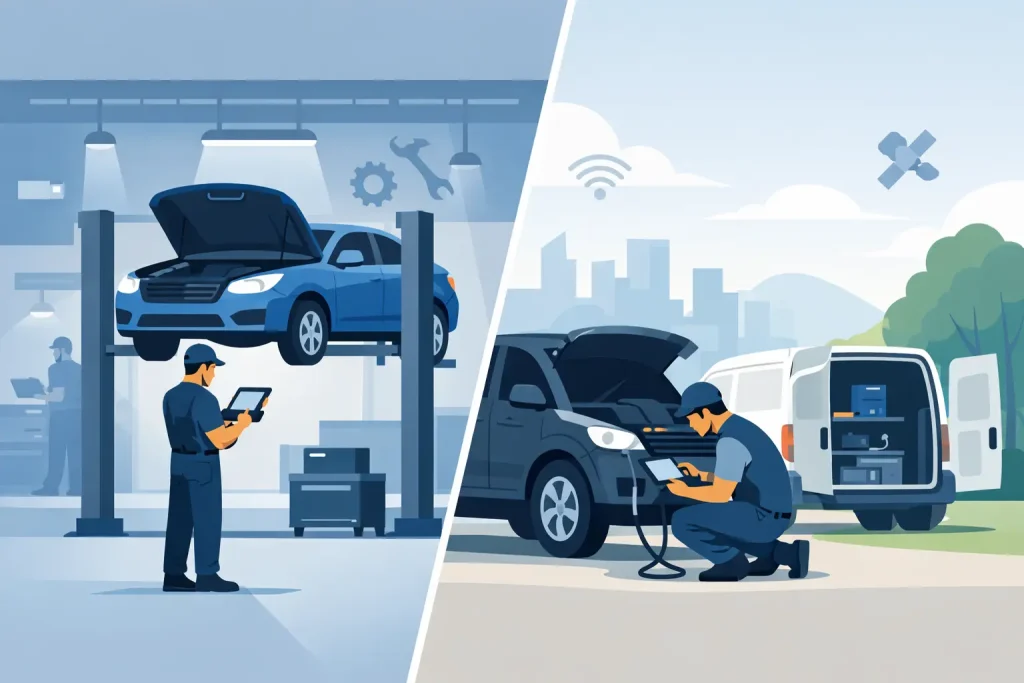
Your van throws an engine warning light on Tuesday morning. By lunch, the dealer can book you in for next week, quote you for parts they have not tested properly yet, and leave you arranging lifts, lost work and a growing headache. That is exactly where dealer repair vs mobile diagnostics stops being a theory and starts costing you real money.
If you rely on your vehicle, the difference matters. Not because dealers are always wrong, and not because mobile diagnostics are magic. It matters because the right route depends on the fault, the age of the vehicle, your budget, and how quickly you need the problem sorted without getting dragged into a long chain of guesswork.
Dealer repair vs mobile diagnostics – what is the real difference?
A dealer workshop usually works inside a fixed process. The car goes in, fault codes are read, manufacturer procedures are followed, and if the system points to a failed component, that component is often replaced. For newer vehicles under warranty, that can make perfect sense. If the manufacturer is footing the bill, sticking to the official path is usually the safest option.
Mobile diagnostics works differently. The technician comes to you, tests the vehicle where it is, and focuses on finding the actual cause before parts are thrown at it. That matters with diesel faults because modern emissions systems are full of linked issues. An AdBlue warning might be the tank, the injector, the pump, the heater, the wiring, the NOx sensor, or a software-related fault. Replace the wrong part and you are still off the road, just poorer.
The biggest difference is mindset. Dealer repair often leans towards replacement. Mobile diagnostics should lean towards diagnosis first, then the most effective fix.
Why diesel faults make the choice harder
Diesel owners know the pattern. One warning light turns into limp mode. A simple message on the dash becomes a list of expensive parts. Then comes the classic line: let us start with this sensor and see how it goes. That is not a fix. That is an expensive experiment.
AdBlue and emissions faults are a perfect example. These systems are notorious for repeat failures, especially on higher-mileage cars, vans and 4x4s. A dealer may quote for a new NOx sensor, then an AdBlue injector, then a DPF-related repair if the first job does not clear the countdown or warning. Sometimes those parts really are dead. Sometimes the fault sits elsewhere and the parts cannon starts firing anyway.
A good mobile specialist is often better placed here because the job is not just to read codes. It is to understand common failure patterns, test live data properly, and know where manufacturers and workshops waste customers’ money. That sort of experience is worth more than a polished waiting area and a service desk.
Cost is not just the invoice
Plenty of drivers compare dealer and mobile options on the repair quote alone. Fair enough, but that is only half the story. The real cost includes recovery, missed work, rental vehicles, repeated visits and the misery of being told to come back when the first repair has not fixed it.
Dealer labour rates are often high before any meaningful work starts. Add genuine parts, workshop overheads and the habit of replacing assemblies rather than chasing a targeted fix, and the bill can get ugly fast. For business users and tradespeople, downtime hurts just as much as the invoice.
Mobile diagnostics can cut that down. You are not losing half a day getting to a workshop and waiting around. The vehicle is inspected where it sits. If the issue is confirmed quickly, you can move straight towards a fix rather than a booking chain. That convenience is not a luxury. For many drivers, it is the only practical way to keep life moving.
That said, mobile service is not always cheaper in every scenario. If your vehicle needs a major mechanical strip-down, ramp access, dealer-only coding or a manufacturer goodwill claim, a workshop may still be the better route. The smart move is knowing when convenience and accurate fault-finding save money, and when a fixed site is genuinely needed.
When dealer repair makes sense
There are times when the dealer is the right answer, and pretending otherwise would be nonsense.
If the vehicle is still under manufacturer warranty, dealer history can protect you. If there is a recall, software campaign or known issue covered by the manufacturer, you should check that first. The same goes for brand-new models with heavily locked systems where independent access is limited.
A dealer can also make sense when the repair is clearly mechanical and manufacturer-specific. Some jobs need specialist workshop tools, alignment procedures or factory approval. If your issue falls into that category, forcing a mobile solution is the wrong move.
The problem is that many diesel fault cases do not sit there. They sit in the messy middle ground where codes exist, symptoms are obvious, but the exact root cause needs proper on-site testing and real-world experience, not automatic part replacement.
When mobile diagnostics wins
Mobile diagnostics comes into its own when the vehicle is stuck, in limp mode, hard to trust, or too important to lose for days. That includes vans on jobs, family diesels with recurring warnings, and work vehicles that cannot keep bouncing between bookings.
It is especially strong for intermittent faults and emissions problems. A mobile technician can inspect the car in the conditions where the problem is actually happening, rather than after it has sat in a workshop queue. That can make a big difference with AdBlue faults, NOx sensor issues and systems that trigger warning messages one day and behave the next.
It also suits owners who are sick of vague answers. You want to know what has failed, what can be tested, what needs repairing, what can be coded, and whether the recommended fix is likely to last. Straight answers matter when you have already spent money and still have the same light on the dash.
This is where a specialist mobile provider has an edge over a general garage as well. Diesel emissions systems are not beginner territory. Pattern failures, software behaviour, sensor interaction and forced derates all need experience. Without that, the diagnosis can look confident while still being miles off.
Dealer repair vs mobile diagnostics for AdBlue faults
This is where the gap often becomes obvious. On paper, AdBlue systems are simple enough. In real life, they are one of the biggest sources of repeat diesel headaches on UK roads.
A dealer approach may follow the official chain: replace the failed item, update the software, clear the fault, retest. Sometimes that sorts it. Sometimes the same vehicle comes back with the same message because another linked fault was missed or the system itself is becoming unreliable with age.
A mobile diagnostics specialist is more likely to approach the issue from the customer side first. Is this vehicle worth pouring repeated dealer-level money into? Is the fault isolated, or is it part of a wider pattern of AdBlue system failure? Is a repair sensible, or are you about to get trapped in a cycle of sensors, injectors and countdown warnings?
That is why drivers facing repeated emissions faults often look beyond the dealer network. They are not chasing ceremony. They want the vehicle rescued, the fault understood, and a path that makes financial sense.
The risk on both sides
Let us keep it honest. There are bad dealer experiences and bad mobile operators. A dealer can over-prescribe parts. A mobile technician can overpromise and under-test. The badge on the shirt means nothing if the diagnosis is weak.
What matters is method. Are they testing, or guessing? Are they explaining the likely cause in plain English? Are they clear about what they can confirm on site and what they cannot? Are they honest if the job needs workshop work after all?
A proper specialist should never hide behind jargon. If somebody cannot explain why they think a part has failed, you should be cautious. If the whole plan is based on one code and a shrug, walk away.
What most drivers actually need
Most people are not looking for a lecture on emissions architecture. They want the vehicle fixed quickly, at sensible cost, with as little disruption as possible. They want someone who knows the difference between a genuine failed component and a fault code that points in the wrong direction.
That is why mobile diagnostics has grown so quickly in this space. It matches real life. People have jobs, deliveries, school runs and deadlines. They cannot keep surrendering their vehicle to a workshop every time the dash lights up.
For the right faults, the mobile route is not the compromise. It is the more practical option. And when the technician knows diesel systems inside out, it can be the more accurate one too.
If you are stuck choosing between the two, forget the sales pitch and look at the facts in front of you: warranty status, fault type, urgency, likely downtime and whether you need diagnosis or just parts fitted. The choice is yours, but for many diesel owners dealing with repeat warnings and emissions grief, a sharp mobile specialist like Bolt Remaps makes a lot more sense than joining the dealer queue again.
The best repair path is the one that gets your vehicle back to work without draining your wallet or your patience.