AdBlue Consumption Too High: Causes and What to Check
Owning a diesel · Published
If you seem to be filling the AdBlue tank far more often than before, something may be wrong. Here is how to tell normal use from a fault.
In short
- Normal AdBlue use varies by make, engine and how the vehicle is driven. Check your handbook.
- A sudden jump in use is a better clue than the amount itself.
- Leaks, a misreading level sender, a NOx sensor reading high or engine faults can all raise use.
- Look for wet patches and white crust, and note how far each tank lasts.
What normal AdBlue use looks like
There is no single right figure. How much AdBlue a diesel uses depends on the make, the engine and the way it is driven. Your handbook gives the expected use for your vehicle, so check there first.
Heavy loads use more. So does towing, fast motorway driving and lots of hard acceleration. A lightly loaded car on gentle runs will use less. Winter and short trips can change the picture too.
The most useful habit is to notice your own pattern. If one tank used to last a certain distance and now lasts clearly less, that change is what matters.
Signs the use is genuinely too high
A clear drop in distance per tank
You are topping up much sooner than you used to, with no change in the way you drive or what you carry.
The level falls quickly on the gauge
The display seems to drop faster than your driving explains. This can mean real loss or a reading that is wrong.
Wet marks or white crust
A leak often leaves a damp patch or a hard white deposit where the fluid dried. It may appear under the vehicle or on the tank, lines or injector.
A warning with no obvious reason
A low level message that arrives early, or a fault light alongside high use, suggests the system is not behaving normally.
The real causes
Most cases fall into a handful of groups.
Leaks at the lines, injector or tank
AdBlue is a thin fluid and finds small gaps. Worn connectors, cracked lines, a leaking injector seal or a damaged tank can all lose fluid. It dries into white crust, which is the tell-tale sign.
A faulty level sender
The sender measures how much is in the tank. If it reads wrongly, the gauge may fall faster than the real level. You think you are using a lot when the tank is actually fine, or the reverse.
A NOx sensor reading too high
The system uses NOx sensors to decide how much fluid to spray. If a sensor reads higher than the true level, the system adds more AdBlue to compensate. It over-doses, and use climbs for no real reason.
Engine problems raising NOx
If the engine really is making more NOx than it should, the system doses harder to cope. Issues with the EGR valve, the particulate filter or fuelling can do this. The AdBlue use is a symptom of the engine fault, not the cause.
Poor quality fluid
Weak or diluted fluid cannot treat as much gas per dose, so the system sprays more of it. It may also raise a quality warning.
How to check it yourself
A few simple checks tell you a lot before you pick up the phone. None of them need tools.
Track a full tank
Fill to the top, reset your trip meter and note the distance until the next top-up. Do it twice. One figure can mislead, two give a pattern.
Look for leaks
With the vehicle parked, look under it and around the filler and tank for damp patches or white crust. Check the ground where it normally sits.
Check the fluid
Make sure you use fluid that meets ISO 22241 and is in date. Avoid cheap unknown products.
Note any warnings
Write down any lights or messages and what they say. This helps whoever looks at the vehicle.
What not to do
Do not run the tank low to save money. Letting it run empty can trigger a countdown and may stop the vehicle restarting.
Never try to switch off or bypass the AdBlue system to cut costs. That is illegal in the UK and will fail an emissions check. If use is too high, the answer is to fix the cause.
A new NOx sensor or injector is not a guess. Parts should be changed only when live data shows they are the problem.
When to call us
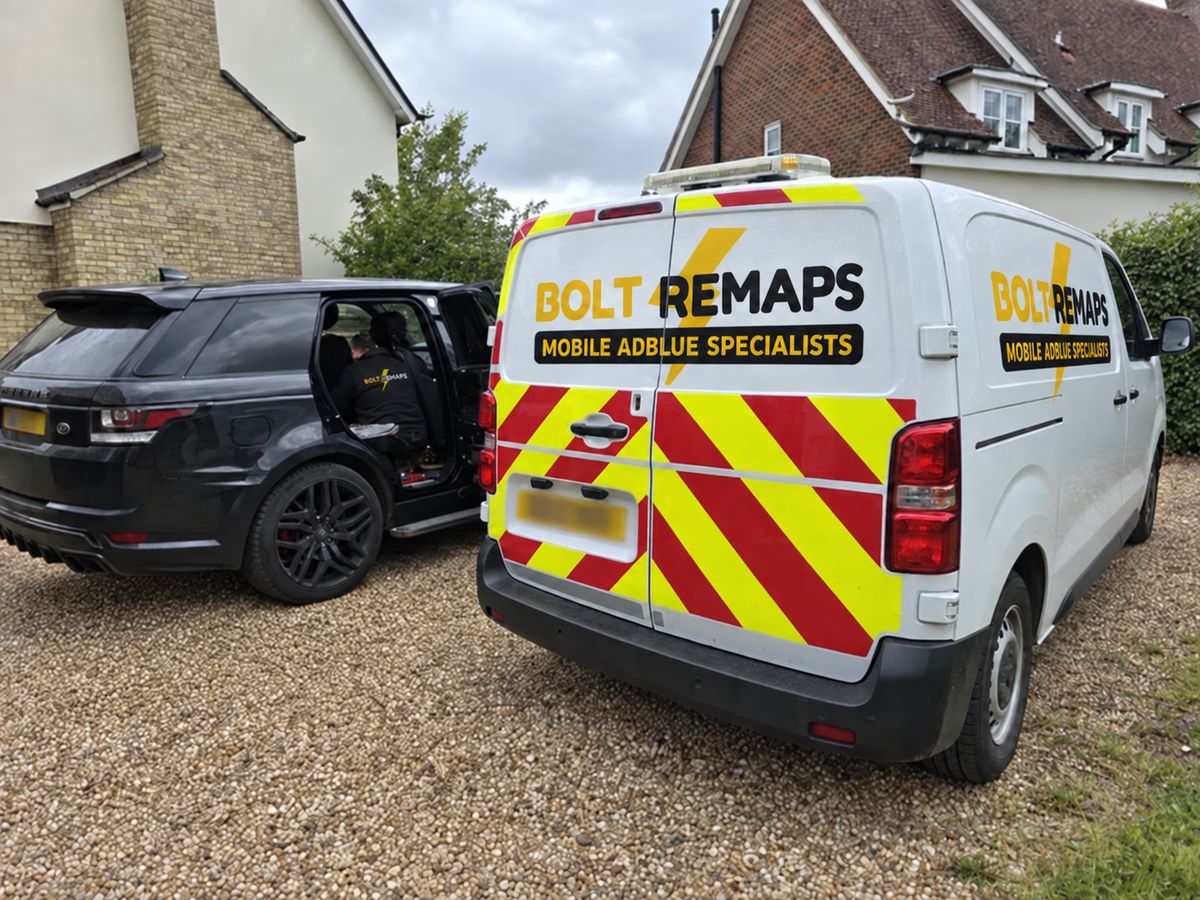
Bolt Remaps has fixed AdBlue faults since 2019, and we are IMI affiliated. We are fully mobile and visit your home, workplace or roadside. You can reach us from 6am to 9pm, seven days a week, bank holidays included.
We check for leaks, read the sensors and find why the system is using too much, then agree a fixed price after diagnosis. Work starts from £249, with no fix no fee on the agreed outcome and a written warranty. Call 0203 038 8555.
Common questions
How much AdBlue should my car use?
It varies by make, engine and driving style. Your handbook gives the expected use for your vehicle. A sudden change from your own normal is the clearest warning.
Does towing use more AdBlue?
Yes. Heavy loads, towing and fast motorway driving make the engine work harder, so the system doses more. That is normal and not a fault.
Why is my AdBlue disappearing so quickly?
Possible reasons are a leak, a level sender misreading, a NOx sensor reading high or an engine fault raising emissions. Checking for white crust and tracking each tank helps narrow it down.
What does white crust around the AdBlue tank mean?
It is usually dried AdBlue from a small leak. Check the lines, the injector and the tank seams, and get it looked at before the level drops further.
Can a faulty NOx sensor make me use more AdBlue?
Yes. If it reads higher than the true level, the system adds extra fluid to compensate. A proper diagnosis will show whether the sensor is the cause.
Can you check my AdBlue use at my home?
Yes. We are fully mobile and can inspect, test and repair on your drive or at your workplace. The phone line, 0203 038 8555, is staffed 6am to 9pm daily.